Ontario

Join 15,000+ Ontario students mastering MCR3U
Why MCR3U Students Choose StudyPug
Three ways you get help — even when you’re stuck
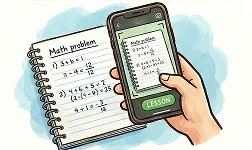
Search with Photo
Snap a photo of any problem and get the exact lesson
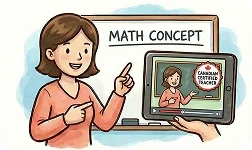
Expert Video Teaching
Certified teachers explain every concept with clear examples

Unlimited Practice
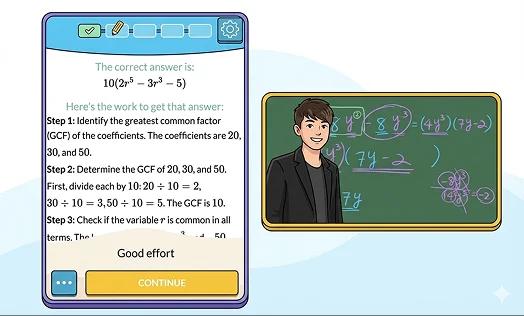
Thousands of practice questions with step-by-step solutions
How StudyPug Works for You
1

Pick Your Course
Choose Grade 11 Functions (MCR3U) and see every topic from your class
2

Get Unstuck
Upload homework problems or browse curriculum-aligned lessons.
3

Practice & Master
Work through similar problems until concepts stick.
4

See Results
Track exactly what you've mastered.
Find the right Ontario Grade 11 course
Ontario Grade 11 Functions (MCR3U) | StudyPugHelp
OE_ID | Expectations | StudyPug Topic |
|---|---|---|
ON.OE.11F.A1.1 | 11F.A1.1: Explain the meaning of the term function, and distinguish a function from a relation that is not a function, through investigation of linear and quadratic relations using a variety of representations (i.e., tables of values, mapping diagrams, graphs, function machines, equations) and strategies (e.g., identifying a one-to-one or many-to-one mapping; using the vertical-line test) |
ON.OE.11F.A1.2 | 11F.A1.2: Represent linear and quadratic functions using function notation, given their equations, tables of values, or graphs, and substitute into and evaluate functions |
ON.OE.11F.A1.3 | 11F.A1.3: Explain the meanings of the terms domain and range, through investigation using numeric, graphical, and algebraic representations of the functions f(x) = x, f(x) = x^2, f(x) = ?x, and f(x) = 1/x; describe the domain and range of a function appropriately; and explain any restrictions on the domain and range in contexts arising from real-world applications |
ON.OE.11F.A1.4 | 11F.A1.4: Relate the process of determining the inverse of a function to their understanding of reverse processes |
ON.OE.11F.A1.5 | 11F.A1.5: Determine the numeric or graphical representation of the inverse of a linear or quadratic function, given the numeric, graphical, or algebraic representation of the function, and make connections between the graph of a function and the graph of its inverse |
ON.OE.11F.A1.6 | 11F.A1.6: Determine the relationship between the domain and range of a function and the domain and range of the inverse relation, and determine whether or not the inverse relation is a function |
ON.OE.11F.A1.8 | 11F.A1.8: Determine, through investigation using technology, the roles of the parameters a, k, d, and c in functions of the form y = af(k(x ? d)) + c, and describe these roles in terms of transformations on the graphs of f(x) = x, f(x) = x^2, f(x) = ?x, and f(x) = 1/x |
ON.OE.11F.A1.9 | 11F.A1.9: Sketch graphs of y = af(k(x ? d)) + c by applying one or more transformations to the graphs of f(x) = x, f(x) = x^2, f(x) = ?x, and f(x) = 1/x, and state the domain and range of the transformed functions |
ON.OE.11F.A2.1 | 11F.A2.1: Determine the number of zeros of a quadratic function, using a variety of strategies |
ON.OE.11F.A2.2 | 11F.A2.2: Determine the maximum or minimum value of a quadratic function whose equation is given in the form f(x) = ax^2 + bx + c, using an algebraic method |
ON.OE.11F.A2.3 | 11F.A2.3: Solve problems involving quadratic functions arising from real-world applications and represented using function notation |
ON.OE.11F.A2.4 | 11F.A2.4: Determine, through investigation, the transformational relationship among the family of quadratic functions that have the same zeros, and determine the algebraic representation of a quadratic function, given the real roots of the corresponding quadratic equation and a point on the function |
ON.OE.11F.A2.5 | 11F.A2.5: Solve problems involving the intersection of a linear function and a quadratic function graphically and algebraically |
ON.OE.11F.A3.1 | 11F.A3.1: Simplify polynomial expressions by adding, subtracting, and multiplying |
ON.OE.11F.A3.2 | 11F.A3.2: Verify, through investigation with and without technology, that ?ab = ?a ? ?b, a ? 0, b ? 0, and use this relationship to simplify radicals and radical expressions obtained by adding, subtracting, and multiplying |
ON.OE.11F.A3.3 | 11F.A3.3: Simplify rational expressions by adding, subtracting, multiplying, and dividing, and state the restrictions on the variable values |
ON.OE.11F.B1.1 | 11F.B1.1: Graph, with and without technology, an exponential relation, given its equation in the form y = a^x (a > 0, a ? 1), define this relation as the function f(x) = a^x, and explain why it is a function |
ON.OE.11F.B1.2 | 11F.B1.2: Determine, through investigation using a variety of tools and strategies, the value of a power with a rational exponent |
ON.OE.11F.B1.3 | 11F.B1.3: Simplify algebraic expressions containing integer and rational exponents, and evaluate numeric expressions containing integer and rational exponents and rational bases |
ON.OE.11F.B2.2 | 11F.B2.2: Determine, through investigation using technology, the roles of the parameters a, k, d, and c in functions of the form y = af(k(x ? d)) + c, and describe these roles in terms of transformations on the graph of f(x) = a^x (a > 0, a ? 1) |
ON.OE.11F.B2.4 | 11F.B2.4: Determine, through investigation using technology, that the equation of a given exponential function can be expressed using different bases, and explain the connections between the equivalent forms in a variety of ways |
ON.OE.11F.B2.5 | 11F.B2.5: Represent an exponential function with an equation, given its graph or its properties |
ON.OE.11F.B3.2 | 11F.B3.2: Identify exponential functions, including those that arise from real-world applications involving growth and decay, given various representations, and explain any restrictions that the context places on the domain and range |
ON.OE.11F.C1.1 | 11F.C1.1: Make connections between sequences and discrete functions, represent sequences using function notation, and distinguish between a discrete function and a continuous function |
ON.OE.11F.C1.5 | 11F.C1.5: Determine, through investigation, recursive patterns in the Fibonacci sequence, in related sequences, and in Pascal's triangle, and represent the patterns in a variety of ways |
ON.OE.11F.C1.6 | 11F.C1.6: Determine, through investigation, and describe the relationship between Pascal's triangle and the expansion of binomials, and apply the relationship to expand binomials raised to whole-number exponents |
ON.OE.11F.C2.1 | 11F.C2.1: Identify sequences as arithmetic, geometric, or neither, given a numeric or algebraic representation |
ON.OE.11F.C2.3 | 11F.C2.3: Determine the formula for the sum of an arithmetic or geometric series, through investigation using a variety of tools and strategies, and apply the formula to calculate the sum of a given number of consecutive terms |
ON.OE.11F.C3.1 | 11F.C3.1: Make and describe connections between simple interest, arithmetic sequences, and linear growth, through investigation with technology |
ON.OE.11F.C3.2 | 11F.C3.2: Make and describe connections between compound interest, geometric sequences, and exponential growth, through investigation with technology |
ON.OE.11F.C3.5 | 11F.C3.5: Explain the meaning of the term annuity, and determine the relationships between ordinary simple annuities, geometric series, and exponential growth, through investigation with technology |
ON.OE.11F.D1.1 | 11F.D1.1: Determine the exact values of the sine, cosine, and tangent of the special angles: 0?, 30?, 45?, 60?, and 90? |
ON.OE.11F.D1.3 | 11F.D1.3: Determine the measures of two angles from 0? to 360? for which the value of a given trigonometric ratio is the same |
ON.OE.11F.D1.4 | 11F.D1.4: Define the secant, cosecant, and cotangent ratios for angles in a right triangle in terms of the sides of the triangle, and relate these ratios to the cosine, sine, and tangent ratios |
ON.OE.11F.D1.5 | 11F.D1.5: Prove simple trigonometric identities, using the Pythagorean identity sin^2 x + cos^2 x = 1; the reciprocal identities secx = 1/cosx, cscx = 1/sinx, and cotx = 1/tanx; the quotient identity tanx = sinx/cosx; and the Pythagorean identities 1 + tan^2 x = sec^2 x and 1 + cot^2 x = csc^2 x |
ON.OE.11F.D1.6 | 11F.D1.6: Pose problems involving right triangles and oblique triangles in two-dimensional settings, and solve these and other such problems using the primary trigonometric ratios, the cosine law, and the sine law (including the ambiguous case) |
ON.OE.11F.D2.1 | 11F.D2.1: Describe key properties of periodic functions arising from real-world applications, given a numeric or graphical representation |
ON.OE.11F.D2.5 | 11F.D2.5: Determine, through investigation using technology, the roles of the parameters a, k, d, and c in functions of the form y = af(k(x ? d)) + c, where f(x) = sinx or f(x) = cosx with angles expressed in degrees, and describe these roles in terms of transformations on the graphs of f(x) = sinx and f(x) = cosx |
ON.OE.11F.D2.8 | 11F.D2.8: Represent a sinusoidal function with an equation, given its graph or its properties |
ON.OE.11F.D3.2 | 11F.D3.2: Identify periodic and sinusoidal functions, including those that arise from real-world applications involving periodic phenomena, given various representations, and explain any restrictions that the context places on the domain and range |
Complete MCR3U Coverage
Topics Covered
69
Video Lessons
406
Practice Questions
757
Step-by-Step Solutions
803
Why Ontario MCR3U Students Love StudyPug
Built specifically for Ontario high school success
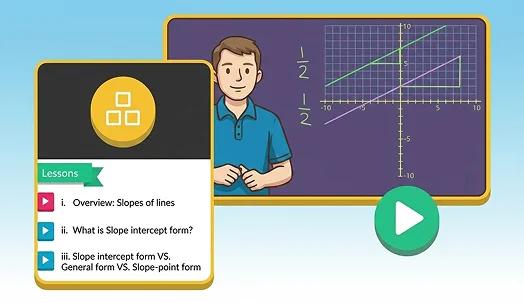
Ontario Curriculum Aligned
Every lesson matches Ontario Grade 11 Functions standards—what you learn in class, we teach

EQAO Math Prep
Practice with Ontario graduation numeracy assessment questions—be ready for exam day
OCT-Certified Teachers
Learn from expert Ontario teachers who know exactly what you need for MCR3U
Learn Anywhere
Desktop, tablet, or phone—your MCR3U lessons sync across all devices
Frequently Asked Questions
Everything you need to know about mastering MCR3U with StudyPug
What does Grade 11 Functions (MCR3U) coverage include?
Our MCR3U course covers all four strands: Characteristics of Functions (quadratic, reciprocal, inverse functions), Exponential Functions (graphing, transformations, growth/decay), Discrete Functions (sequences, series, financial applications), and Trigonometric Functions (ratios, identities, sinusoidal functions). We have 69 topics, 406 video lessons, and 803 practice questions aligned to the Ontario curriculum.
How does photo search work for MCR3U homework?
Snap a photo of any MCR3U problem—quadratic equations, trig identities, exponential graphs—and our AI matches you to the exact video lesson. You get step-by-step explanations from Ontario-certified teachers, plus similar practice problems to master the concept. It works on desktop, tablet, or phone, so you can get help anywhere.
How many practice problems are available for MCR3U?
We have 803 practice questions for MCR3U, covering every topic from quadratic functions to sinusoidal graphs. Each question includes full step-by-step solutions so you can see exactly where you went wrong. Practice adapts to your level—questions get harder as you improve, keeping you challenged without overwhelming you.
What if I'm falling behind in Grade 11 Functions?
Start with our diagnostic to identify exactly what you're struggling with—whether it's exponential transformations, trig ratios, or sequence formulas. Then watch targeted video lessons at your own pace. You can pause, rewind, and rewatch until concepts click. Thousands of Ontario students have caught up and improved their MCR3U grades using StudyPug.
Does StudyPug help with MCR3U exams and tests?
Yes. We have practice questions aligned to MCR3U unit tests and the Ontario graduation numeracy assessment. Work through full problem sets with step-by-step solutions to build confidence before exam day. Students report going from failing to 70s and 80s after using our test prep tools.
How much does StudyPug cost?
StudyPug offers flexible monthly and annual plans starting at $19.99/month. You get unlimited access to all 406 MCR3U video lessons, 803 practice questions, photo search, and progress tracking. No commitments—cancel anytime. Many students see grade improvements within the first month. Try it risk-free and see results fast.
Smart Study Tools for Real Results
Personalized features that help you stay motivated and make progress
Adaptive Practice
Questions adapt to your level
Stay Motivated
Badges and streaks keep you practising daily
Quiz Mastery
Retake quizzes until you truly get it
Progress Tracking
See exactly where you need more practice