Alberta

Join 40,000+ Alberta students getting ahead in Math 20-1
Why Mathematics 20-1 Students Choose StudyPug
Three ways you get help — even when you’re stuck
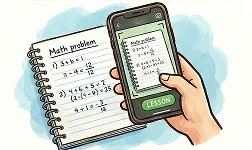
Search with Photo
Snap a photo of any problem and get the exact lesson
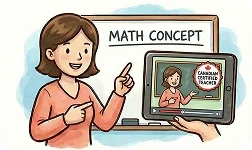
Expert Video Teaching
Certified teachers explain every concept with clear examples

Unlimited Practice
Thousands of practice questions with step-by-step solutions
How StudyPug Works For You
1
Pick Your Course
Choose Mathematics 20-1 and see every topic from your class
2

Get Unstuck
Upload homework problems or browse curriculum-aligned lessons.
3
Practice & Master
Work through similar problems until concepts stick.
4

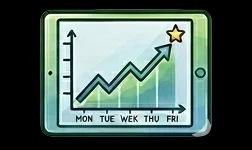
See Results
Track exactly what you've mastered.
Find the right Alberta Grade 11 course
Master Alberta Mathematics 20-1 | StudyPugHelp
LO_ID | Learning Outcome-Skills & Procedures | StudyPug Topic |
|---|---|---|
AB.SO.20-1.1 | Demonstrate an understanding of the absolute value of real numbers: Determine the distance of two real numbers from 0 on a number line and relate to absolute value; Determine the absolute value of positive and negative real numbers; Explain how distance between points on a number line relates to absolute value; Determine the absolute value of numerical expressions; Compare and order absolute values of real numbers |
AB.SO.20-1.2 | Solve problems that involve operations on radicals and radical expressions with numerical and variable radicands: Compare and order radical expressions with numerical radicands; Express entire radicals as mixed radicals and vice versa; Perform operations to simplify radical expressions; Rationalize denominators of rational expressions; Identify values for which radical expressions are defined; Solve problems involving radical expressions |
AB.SO.20-1.3 | Solve problems that involve radical equations (limited to square roots): Determine restrictions on variables in radical equations; Solve radical equations algebraically; Verify solutions by substitution; Explain why some algebraically determined roots are extraneous; Solve problems by modeling situations using radical equations |
AB.SO.20-1.4 | Determine equivalent forms of rational expressions (limited to numerators and denominators that are monomials, binomials or trinomials): Compare strategies for rational expressions to those for rational numbers; Explain non-permissible values for rational expressions; Determine equivalent rational expressions by multiplying numerator and denominator; Simplify rational expressions; Explain why non-permissible values remain the same after simplification; Identify and correct errors in simplification of rational expressions |
AB.SO.20-1.5 | Perform operations on rational expressions (limited to numerators and denominators that are monomials, binomials or trinomials): Compare strategies for operations on rational expressions to those on rational numbers; Determine non-permissible values when performing operations; Determine sums and differences of rational expressions; Determine products and quotients of rational expressions; Simplify expressions involving multiple operations on rational expressions |
AB.SO.20-1.6 | Solve problems that involve rational equations (limited to numerators and denominators that are monomials, binomials or trinomials): Determine non-permissible values for variables in rational equations; Solve rational equations algebraically; Explain why some algebraically determined values may not be solutions; Solve problems by modeling situations using rational equations |
AB.SO.20-1.7 | Demonstrate an understanding of angles in standard position 0° to 360°: Sketch angles in standard position; Determine reference angles for angles in standard position; Explain how to determine angles from 0° to 360° with the same reference angle; Illustrate reflection of reference angles in x-axis and y-axis; Determine quadrants for angles in standard position; Draw angles given points on terminal arms; Illustrate points on terminal sides with same reference angle |
AB.SO.20-1.8 | Solve problems, using the three primary trigonometric ratios for angles from 0° to 360° in standard position: Determine distance from origin to points using Pythagorean theorem or distance formula; Calculate trigonometric ratios given points on terminal arms; Determine signs of trigonometric ratios for given angles; Solve trigonometric equations; Determine exact values of trigonometric ratios for special angles; Describe patterns in trigonometric ratio values; Sketch diagrams to represent problems; Solve contextual problems using trigonometric ratios |
AB.SO.20-1.9 | Solve problems, using the cosine law and sine law, including the ambiguous case: Sketch diagrams for non-right triangle problems; Solve non-right triangles using primary trigonometric ratios; Explain steps in proofs of sine and cosine laws; Solve problems using cosine and sine laws; Describe situations with no solution, one solution, or two solutions |
AB.SO.20-1.10 | Factor polynomial expressions of various forms: Factor expressions requiring identification of common factors; Determine if binomials are factors of polynomial expressions; Factor quadratic expressions and expressions with quadratic patterns |
AB.SO.20-1.12 | Analyze quadratic functions of the form y = a(x - p)² + q and determine their characteristics: Explain why given functions are quadratic; Compare graphs of quadratic functions to y = x²; Generalize rules about effects of a, p, and q on quadratic function graphs; Determine vertex coordinates for quadratic functions; Sketch graphs of quadratic functions using transformations; Explain how a and q affect x-intercepts of quadratic functions; Write quadratic functions for given graphs or characteristics |
AB.SO.20-1.13 | Analyze quadratic functions of the form y = ax² + bx + c to identify characteristics of the corresponding graph: Explain the process of completing the square; Convert quadratic functions between y = ax² + bx + c and y = a(x - p)² + q forms; Identify and correct errors in completing the square; Determine characteristics of quadratic functions in y = ax² + bx + c form; Sketch graphs of quadratic functions in y = ax² + bx + c form; Verify equivalence of different forms of quadratic functions; Write quadratic functions to model situations; Solve problems by analyzing quadratic functions |
AB.SO.20-1.14 | Solve problems that involve quadratic equations: Explain relationships among roots, zeros, and x-intercepts of quadratic functions; Derive the quadratic formula; Solve quadratic equations using various strategies; Select and justify methods for solving quadratic equations; Use the discriminant to determine the nature of roots; Identify and correct errors in quadratic equation solutions; Solve problems involving quadratic equations |
AB.SO.20-1.15 | Solve, algebraically and graphically, problems that involve systems of linear-quadratic and quadratic-quadratic equations in two variables: Model situations using systems of equations; Relate systems of equations to problem contexts; Solve systems graphically using technology; Solve systems algebraically; Explain the meaning of intersection points; Explain why systems may have zero, one, two, or infinite solutions; Solve problems involving systems of equations |
AB.SO.20-1.16 | Solve problems that involve linear and quadratic inequalities in two variables: Explain use of test points to determine solution regions; Explain when to use solid or broken lines in inequality solutions; Sketch graphs of linear and quadratic inequalities; Solve problems involving linear and quadratic inequalities |
AB.SO.20-1.17 | Solve problems that involve quadratic inequalities in one variable: Determine solutions to quadratic inequalities using various strategies; Represent and solve problems involving quadratic inequalities; Interpret solutions to quadratic inequality problems |
AB.SO.20-1.18 | Analyze arithmetic sequences and series to solve problems: Identify assumptions in arithmetic sequences and series; Provide examples of arithmetic sequences; Derive rules for general terms of arithmetic sequences; Describe relationships between arithmetic sequences and linear functions; Determine various elements of arithmetic sequences and series; Derive sum formulas for arithmetic series; Solve problems involving arithmetic sequences and series |
AB.SO.20-1.19 | Analyze geometric sequences and series to solve problems: Identify assumptions in geometric sequences and series; Provide examples of geometric sequences; Derive rules for general terms of geometric sequences; Determine various elements of geometric sequences and series; Derive sum formulas for geometric series; Generalize rules for infinite geometric series; Explain convergence and divergence of geometric series; Solve problems involving geometric sequences and series |
AB.SO.20-1.20 | Graph and analyze reciprocal functions (limited to the reciprocal of linear and quadratic functions): Compare graphs of reciprocal functions to their corresponding functions; Identify characteristics of reciprocal function graphs; Explain the relationship between non-permissible values and vertical asymptotes; Graph reciprocal functions with and without technology; Graph original functions given their reciprocal functions |
Complete Mathematics 20-1 Coverage
Topics Covered
78
Video Lessons
518
Practice Questions
1102
Alberta Curriculum Aligned
100%
Why Alberta Mathematics 20-1 Students Love StudyPug
Built specifically for Alberta high school success
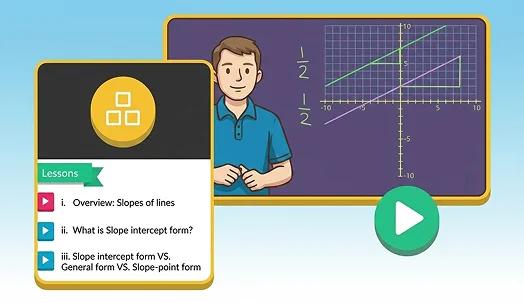
Alberta Curriculum Aligned
Every lesson matches Alberta Mathematics 20-1 standards—what you learn in class, we teach
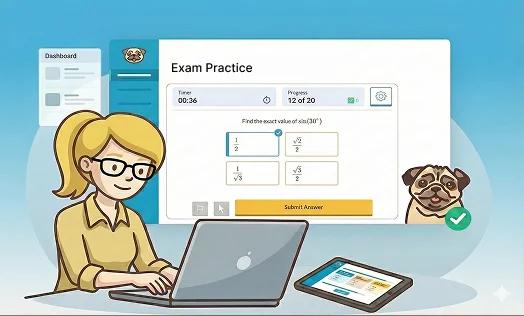
Diploma Exam Prep
Practice with Alberta diploma exam-style questions—be ready for exam day
Alberta-Certified Teachers
Learn from expert Alberta teachers who know exactly what you need for Math 20-1
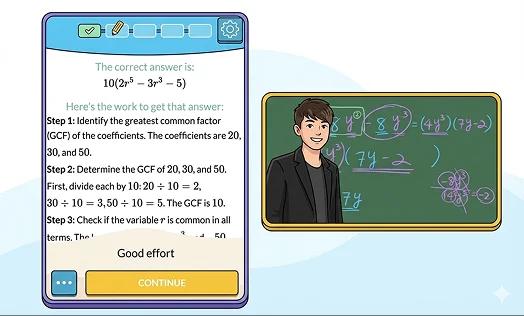
Learn Anywhere
Desktop, tablet, or phone—your Math 20-1 lessons sync across all devices
Mathematics 20-1 Questions Answered
Everything you need to know about mastering Mathematics 20-1 with StudyPug
What does Mathematics 20-1 coverage include?
Our Math 20-1 course covers all Alberta curriculum outcomes: absolute value functions, radical and rational expressions, trigonometry (sine and cosine laws), quadratic functions and equations, systems of equations, inequalities, arithmetic and geometric sequences and series, and reciprocal functions. You get 518 video lessons, 1,124 practice questions, and step-by-step solutions aligned with your textbook.
How does photo search work for Math 20-1?
Snap a photo of any Math 20-1 problem—whether it's quadratic equations, trigonometry, or rational expressions—and our AI instantly finds matching video lessons and practice questions. You get step-by-step explanations that show exactly how to solve problems like yours. It works on any device and searches across all 518 Math 20-1 lessons to find what you need.
How many practice problems are available for Mathematics 20-1?
You get access to 1,124 practice questions covering every Math 20-1 topic, from absolute value and radicals to sequences and series. Every question includes step-by-step solutions so you can learn from your mistakes. Practice is unlimited—work through problems as many times as you need until concepts stick. Questions are organized by topic so you can focus on exactly what you're learning in class.
What if I'm falling behind in Mathematics 20-1?
Start with the topics you're struggling with—whether it's quadratic functions, trigonometry, or rational expressions. Watch the video lessons at your own pace, pause and rewind as needed, then practice until you feel confident. Our adaptive system identifies weak spots and recommends what to study next. Many students catch up within weeks by focusing on their specific gaps rather than reviewing everything.
Does StudyPug help with Mathematics 20-1 diploma exams?
Yes. Our content is aligned with Alberta Math 20-1 curriculum outcomes and includes diploma exam-style practice questions. You'll work through problems that mirror the format, difficulty, and topics on the actual exam. Video lessons break down common exam question types, and step-by-step solutions show you exactly what markers are looking for. Many students use StudyPug as their primary exam prep tool.
How much does StudyPug cost?
StudyPug offers flexible monthly and annual plans that give you unlimited access to all Math 20-1 content plus our entire library of K-12 and university math courses. You can cancel anytime. Start with a free trial to explore lessons, practice questions, and photo search before committing. No hidden fees, and you can learn on unlimited devices.
Smart Study Tools for Real Results
Personalized features that help you stay motivated and make progress
Adaptive Practice
Questions adapt to your level
Stay Motivated
Badges and streaks keep you practising daily
Quiz Mastery
Retake quizzes until you truly get it
Progress Tracking
See exactly where you need more practice