TOPIC

Conservation of energy

MY PROGRESS

Pug Score

0%

Study Points

+0

Overview

Watch

Read

Next Steps


Get Started

Get unlimited access to all videos, practice problems, and study tools.

Unlimited practice
Full videos

Back to Menu

Topic Progress

Pug Score

0%

Videos Watched

0/0

Read

Not viewed


Study Points

+0

Read

Law of Conservation of Energy

This topic explains the law of conservation of energy: energy is neither created nor destroyed, only transformed between forms such as kinetic and potential energy. Covers the formula for conservation of mechanical energy and worked examples like pendulums and falling objects.

What Is the Law of Conservation of Energy?

The law of conservation of energy states that energy can neither be created nor destroyed. It can only be transformed from one form into another or transferred from one object to another, but the total amount of energy in an isolated system never changes. This is one of the most fundamental principles in all of physics, and it applies to everything from a swinging pendulum to a car engine to the chemical reactions inside your body.

In symbols, if we add up every form of energy in a closed system before and after some event, the totals must match:

\(E_{total,\,initial} = E_{total,\,final}\)

This idea connects directly to the broader topic of work and energy, since doing work on a system is really just transferring energy into or out of it.

Conservation of Mechanical Energy Formula

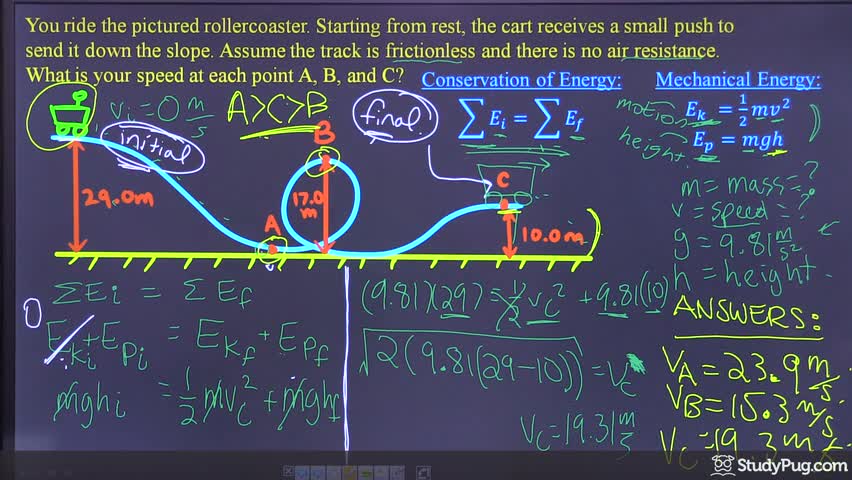
In many introductory problems, we only need to track mechanical energy, which is the sum of kinetic energy (the energy of motion) and potential energy (stored energy due to position, usually height). The conservation of mechanical energy formula is:

\(KE_i + PE_i = KE_f + PE_f\)

where kinetic energy and gravitational potential energy are calculated as:

\(KE = \frac{1}{2}mv^2\)    and    \(PE = mgh\)

Here \(m\) is mass, \(v\) is speed, \(g\) is the acceleration due to gravity, and \(h\) is height above a chosen reference point. This version of the law only holds true when no energy is lost to friction, air resistance, or sound. When those forces are present, some mechanical energy converts into thermal energy, but the total energy of the whole system, mechanical plus thermal plus any other forms, is still conserved.

Energy Transformations: A Pendulum Example

A swinging pendulum is a classic way to see the law of conservation of energy in action. At the highest point of the swing, the pendulum momentarily stops, so all of its mechanical energy is potential energy. As it swings down, that potential energy converts into kinetic energy, reaching maximum speed (and maximum kinetic energy) at the lowest point. As it rises again on the other side, kinetic energy converts back into potential energy.

Point A Point B Point C PE max KE=0 PE=0 KE max PE max KE=0
Orange bars represent potential energy, blue bars represent kinetic energy. Their combined height stays the same at every point, showing conserved mechanical energy.

At every single point along the swing, if you add the kinetic energy and potential energy together, you get the same total value, ignoring the small amount lost to air resistance. This is exactly what the conservation of mechanical energy formula predicts.

Worked Example

A \(2\ \)kg\(\) ball is dropped from a height of \(5\ \)m\(\). Find its speed just before it hits the ground, assuming air resistance is negligible and \(g = 9.8\ \)m/s\(^2\).

At the top, the ball is at rest, so all of its energy is potential: \(PE_i = mgh = (2)(9.8)(5) = 98\ \)J\(\), and \(KE_i = 0\).

Just before hitting the ground, its height is \(0\), so \(PE_f = 0\), and all of the energy has converted into kinetic energy: \(KE_f = 98\ \)J\(\).

Using \(KE_f = \frac{1}{2}mv^2\), solve for \(v\):

\(98 = \frac{1}{2}(2)v^2 \Rightarrow v^2 = 98 \Rightarrow v \approx 9.9\ \)m/s\(\)

Notice that the mass canceled out of the final answer, which is a common feature of free-fall problems solved using conservation of mechanical energy.

Graph of gravitational potential energy versus height for a 2 kilogram mass Plot of y = 2*9.8*x for x in [0, 5] 0 1 2 3 4 5 0 20 40 60 80 100 Height (m) Potential Energy (J) PE = 0 at ground PE = 98 J at h = 5 m
Gravitational potential energy grows linearly with height for a fixed mass; as height decreases during a fall, this energy converts directly into kinetic energy.

Where Does "Lost" Energy Go?

Students sometimes worry that energy "disappears" when a ball stops bouncing or a swing slows down. It doesn't disappear, it transforms into forms that are harder to track, usually heat from friction or air resistance, and sometimes sound. If you could measure every joule of thermal energy released, the books would balance exactly, confirming that energy is neither created nor destroyed, only converted. This distinction between energy conservation and energy efficiency is explored further in power and efficiency, which looks at how usefully energy is transferred rather than whether it is conserved.

Key Takeaways

The law of conservation of energy is a universal principle: the total energy of an isolated system stays constant over time. For mechanical systems free of friction, this simplifies to the conservation of mechanical energy formula, \(KE_i + PE_i = KE_f + PE_f\), which lets you solve for an unknown speed, height, or mass without needing to know anything about the path taken between the initial and final states.

Related lessons